Hymns for the Drowning by Nammalvar
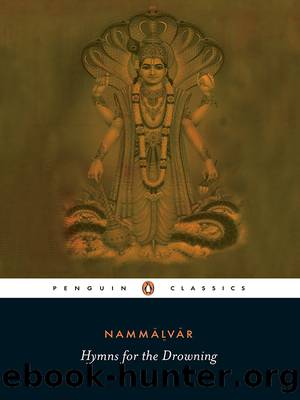
Author:Nammalvar [Nammāḻvār]
Language: eng
Format: epub
ISBN: 9789351187424
Publisher: Penguin Books Ltd
Published: 2014-06-17T00:00:00+00:00
“A Local Habitation and a Name”
By the sixth century, the Sanskrit texts themselves had been classified according to origin and audience as Śruti and sṃṛti. Śrutis were esoteric, “revealed” scripture, the closed texts; the sṃṛtis were “remembered” texts, interpreted by experts, but open to all. The epics, the major Hindu mythologies (purāṇas), and the Gītā were such sṃṛtis; they were part of the direct bhakti inheritance.
In the first regional movements of bhakti, one hears a new kind of utterance that cannot be adequately described by earlier terms such as “heard, revealed” (Śruti) or “remembered” (sṃṛti), or as “that which is known” (the Vedas), or as that which is learned by “sitting at or near the feet [of a teacher]” (the Upaniṣads). For, as the terms suggest, they by now represent passive, receptive modes. Bhaktas prefer the active mode. Nammāḻvār’s text is called Tiru-vāy-moḻi, “holy-mouth-word,” or “divine utterance”; Māṇikkavācakar called his work Tiruvācakam, “the holy utterance”; the Kannada-speaking Vīraśaivas called their poems vacanas or “sayings.” The emphasis has shifted from hearing to speaking, from watching to dancing, from a passive to an active mode; from a religion and a poetry of the esoteric few to a religion and a poetry of anyone who can speak. This shift is paralleled by other religious shifts: from the noniconic to the iconic; from the nonlocal to the local; from the sacrificial-fire rituals (yajña and homo) meant to be performed only by Vedic experts to worship (pūjā) by nearly all; from rituals in which a plot of ground is temporarily cordoned off and made into sacred space by experts in a consecration rite—to worship in temples, localized, named, open to almost the whole range of Hindu society. These changes are accompanied by a shift away from the absolute godhead, the non-personal Brahman of the Upaniṣads, to the gods of the mythologies, with faces, complexions, families, feelings, personalities, characters. Bhakti poems celebrate god both as local and translocal, and especially as the nexus of the two. As the Murukaṉ poem (p. 115) says, he is the kind who dwells “here, but not only here.” The poems celebrate the giving and the receiving, the reciprocity of human and divine.
One must add that bhakti traditions did not entirely discard Upaniṣadic concepts of a non-local, non-concrete godhead. Temples and images were seen by some as the earlier and inferior stages in the path of salvation; the ignorant may need images as props to lean on, but will soon leave them behind to move on to more abstract stages. A distinction is made between a god “with attributes” (saguṇa) and a god “without attributes” (nirguṇa).39 A prayer attributed to Śaṃkara points up the paradox:
O lord, forgive me my three human sins:
you are everywhere, yet I worship you here;
you are without form, yet I worship you
in these, and these other forms;
you need no praise, yet I offer you
this prayer.
Lord, forgive me my three human sins.
But the āḻvār’s god is never nirguṇa, attributeless, never without “body, parts, or passion,” or without a local habitation and a name.
Download
This site does not store any files on its server. We only index and link to content provided by other sites. Please contact the content providers to delete copyright contents if any and email us, we'll remove relevant links or contents immediately.
The Universe of Us by Lang Leav(15126)
The Sun and Her Flowers by Rupi Kaur(14573)
Adultolescence by Gabbie Hanna(8968)
Whiskey Words & a Shovel II by r.h. Sin(8052)
Love Her Wild by Atticus(7795)
Smoke & Mirrors by Michael Faudet(6236)
Wiseguy by Nicholas Pileggi(5857)
The Princess Saves Herself in This One by Amanda Lovelace(5005)
Love & Misadventure by Lang Leav(4885)
Memories by Lang Leav(4849)
Milk and Honey by Rupi Kaur(4780)
Bluets by Maggie Nelson(4607)
Too Much and Not the Mood by Durga Chew-Bose(4393)
Pillow Thoughts by Courtney Peppernell(4333)
Good morning to Goodnight by Eleni Kaur(4263)
The Poetry of Pablo Neruda by Pablo Neruda(4173)
Algedonic by r.h. Sin(4098)
HER II by Pierre Alex Jeanty(3641)
Stuff I've Been Feeling Lately by Alicia Cook(3496)
